
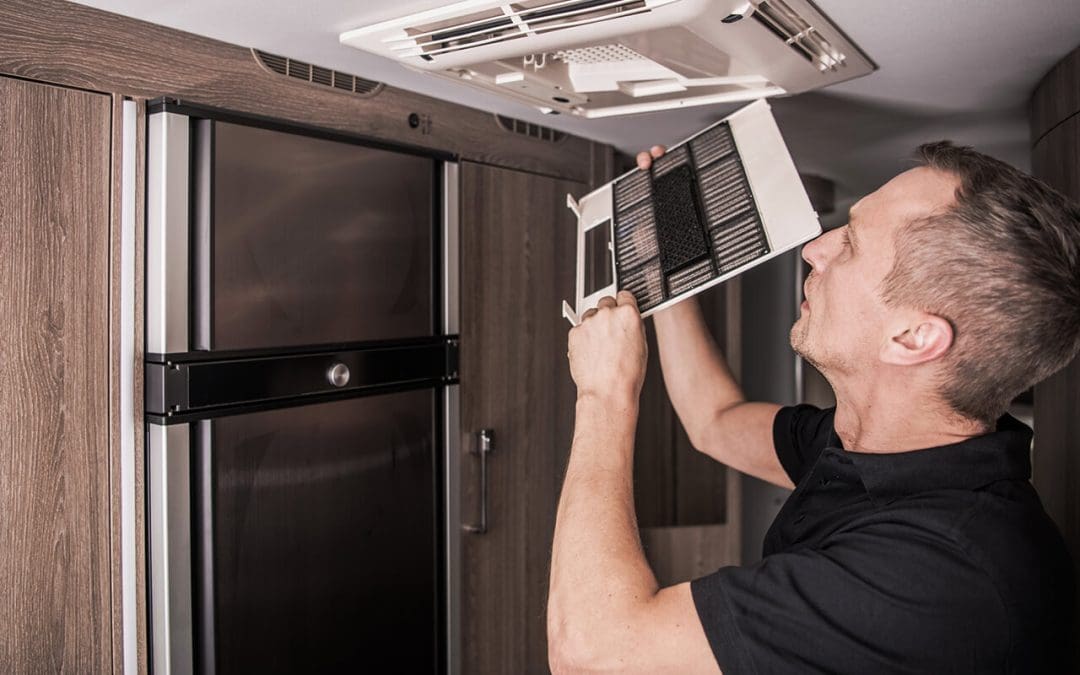
Learning how to keep your RV cool is one of the most important practical skills a summer RVer can develop. An RV heats up faster than a stick-built home, loses heat more slowly when the AC is struggling, and presents cooling challenges that residential strategies don’t address. The RVers who stay genuinely comfortable in summer heat are the ones who reduce the heat load coming in, maximize equipment efficiency, and extend their cooling options when shore power isn’t available.
How to Keep Your RV Cool Before Turning On the AC
The most impactful strategies to keep your RV cool happen before the AC ever comes on. Preventing heat from entering the rig is always more effective than removing it after the fact. Site selection remains the single most powerful tool. A site in deep shade can reduce interior temperatures by fifteen to twenty degrees compared to full sun. When shade isn’t available, orienting the rig so its smaller end faces the afternoon sun and using an awning to shade the largest sun-facing wall reduces solar gain significantly.
Reflective window coverings on every sun-exposed window are the indoor complement to shade. Standard RV curtains allow radiant heat through the glass before blocking it; a reflective foil panel applied directly reflects the majority of solar radiation before it warms the interior. In a rig parked in direct sun, the temperature difference is immediate and significant. When outdoor temperatures drop below indoor temperatures in the evening, opening roof vents and windows creates cross-ventilation that flushes accumulated heat. A powered roof vent fan in exhaust mode accelerates this dramatically and can drop interior temperatures by ten degrees or more within an hour.
AC Performance and Maintenance
An RV air conditioning unit that isn’t properly maintained works significantly harder, produces less cooling, and consumes more power than one that’s in good condition, which matters both for comfort and for the rig’s electrical system. Cleaning the AC filter is the most frequently neglected maintenance step and the one with the most direct impact on cooling performance. A clogged filter restricts airflow across the evaporator coil, reducing the system’s ability to transfer heat and causing the unit to run longer for less output. Most RV AC filters can be removed, rinsed under warm water, dried, and reinstalled. The evaporator and condenser coils also accumulate dust and benefit from annual cleaning with a soft brush or coil cleaner spray. The condenser coil on the roof is particularly important: a dirty condenser raises operating pressure and reduces efficiency. Inspect and clean the roof unit at the start of each season and after travel through dusty conditions.
Off-Grid and Solar Options to Keep Your RV Cool Without Shore Power
For RVers who camp without shore power, keeping the rig cool is a genuine challenge. Standard RV AC units draw 1,200 to 1,500 watts at startup and 700 to 900 watts running, more than most solar and battery systems can sustain continuously. Portable battery-powered personal AC units are a practical supplement for sleeping comfort when the main AC can’t run overnight. They’re not whole-rig solutions, but directed at a sleeping area, they produce meaningful temperature reduction. Larger lithium battery banks, 200 amp-hours or more, paired with 400 watts or more of roof solar can sustain a single rooftop AC unit into the evening hours. This is the configuration that makes genuine off-grid summer camping possible for RVers who want to keep their RV cool without sacrificing comfort.
Frequently Asked Questions (FAQs)
How hot is too hot for an RV AC unit to cool effectively?
Most RV AC units are rated to cool effectively when outdoor temperatures are at or below 100 to 105°F. Above that threshold, the condenser loses efficiency because the temperature differential narrows and the unit’s ability to reject heat decreases. In extreme heat, running the AC continuously and using all passive cooling strategies simultaneously helps maintain tolerable interior temperatures even when the unit is at its limits.
Should I run the AC continuously or cycle it to keep my RV cool?
In sustained high heat, continuous operation is more effective and often more efficient than cycling. A unit that cycles off allows interior temperatures to rise quickly in a small RV volume, requiring harder work at startup to recover. Cycling makes sense in moderate conditions to save power. In high summer heat, continuous operation is usually the better strategy for both comfort and system efficiency.
What is the most energy-efficient way to keep your RV cool off-grid?
The most efficient off-grid approach combines maximum passive cooling with a DC-powered mini-split or portable battery AC unit rather than a standard rooftop unit. Standard rooftop AC units draw heavy startup current that stresses battery systems. DC mini-splits designed for RV use draw significantly less power and run efficiently on solar and lithium battery systems.
How do I know if my RV AC needs to be serviced or replaced?
Signs that service is needed include reduced airflow, the unit running continuously without reaching the thermostat setpoint, ice forming on the evaporator coil, unusual noises, and the unit tripping the breaker on startup. Many of these are resolved with cleaning and filter maintenance. If the unit is more than ten years old and fails to cool despite clean filters and coils, replacement is often more cost-effective than repair.
Can I add a second AC unit to keep my RV cool in extreme heat?
Yes, many larger motorhomes and fifth wheels are pre-wired for a second AC opening in the roof. A second unit doubles cooling capacity and allows different zones to be cooled independently. Confirm the shore power service or generator capacity can support both units simultaneously before installation.
USRV Inspector provides professional RV inspection services to RVers throughout the United States. Contact us to schedule an appointment.